FAQ
Anemo Robotics frequently asked marine biodiversity monitoring questions answered
How do you monitor fish around a wind farm, a port or a reef, and what does it take to do it for a full year? These are the questions we hear most from offshore wind teams, environmental consultancies and marine researchers, answered by Anemo Robotics from the projects we have run.
Last reviewed November 2026
Choosing a monitoring method
How do you monitor fish around an offshore wind farm?
Most fish monitoring programs at offshore wind farms combine methods, because each one answers a different question. Trawl surveys sample the wider area, eDNA shows which species have been present, acoustic telemetry follows tagged animals, and ROV or diver surveys inspect structures on the days a vessel is on site. Fixed underwater cameras add what the others miss: what fish do at one spot, day and night, across seasons.
In RWE’s SeaMe program near Helgoland in the German Bight, nine AnemoLive cameras stand on three seabed landers, 2 m, 10 m and 40 m from reference structures. They record a 30-second clip every 15 minutes around the clock, so fish activity can be compared by distance from the structure. Read the SeaMe case study.
How do you prove nature-inclusive design is working?
To show that nature-inclusive design is working, compare the structure with a matched reference, using the same sampling at both, for at least one full seasonal cycle. That is a control and impact design. The measures that carry the argument are abundance (MaxN), species richness, and whether animals stay and use the structure or only pass by.
At Hollandse Kust West, Ecowende is studying whether fish use water replenishment holes in monopiles as shelter. In the MOSAR reef project in Denmark, the same design showed eight times more detections at reef sites than at matched control sites.
How do you monitor fish around a port or harbor development?
To monitor fish around a port or harbor development, record a baseline before construction, keep the same camera positions through the works and afterward, and add a reference site outside the footprint. Ports suit wired cameras: power and network are usually within cable reach, so cameras can stream live and need no battery visits. Turbidity is the main limit, so check visibility at the site before fixing the design.
At the Port of Bilbao, six AnemoLive cameras ran for 12 months on ECOncrete coastal armor blocks and on conventional armor beside them. In Copenhagen’s Nordhavn, two AnemoLive cameras at about 6 m depth stream live from a stone reef.
How do you monitor fish on an artificial reef over a full year?
To monitor fish on an artificial reef for a full year, use fixed cameras that record short clips at set intervals, at reef sites and at matched control sites, and plan service visits around battery and storage. A full year matters because fish use of a reef changes with season, time of day and water temperature. A few survey days cannot separate the reef’s effect from that background.
The MOSAR project, led by ReefCircular with DTU Aqua at Hundested, Denmark, ran from June 2024 to June 2025 with six AnemoCam cameras, three at reef sites and three at matched controls. It recorded eight times more detections at reef sites, a 400 percent increase in abundance and a 200 percent increase in diversity across 18 mobile species.
eDNA or underwater cameras: which should you use?
Use eDNA to learn which species are present, and cameras to learn what they do and how many use a site. eDNA picks up genetic traces from a water sample, including rare species and ones that hide from view. It says little about behavior, size or time of day, and abundance estimates from it remain uncertain. Cameras give counts (MaxN), activity through day and night and habitat use, but only within their field of view.
What are the alternatives to BRUVs for monitoring fish?
The main alternatives to BRUVs are unbaited remote video, long-term fixed cameras, diver visual census, eDNA and acoustic methods. BRUVs are a well-established standard: about 60 minutes per drop, with bait drawing fish to the camera. That makes them efficient for species inventories. But bait changes behavior, drawing in more predators and scavengers, and every drop needs a boat.
Unbaited fixed cameras trade bait for time. They stay for months and record how fish use a site undisturbed. In the Maldives, Van Oord Ocean Health deployed seven AnemoCam cameras without bait across artificial reef sites and a natural reef reference site. If you already run BRUVs, that footage can be analyzed in AnemoHub.
Are underwater cameras cheaper than diver surveys?
For one short survey, diver surveys usually cost less than cameras. For repeated surveys or a long program, cameras usually cost less. Diver surveys cost little to set up, but every visit needs a vessel, a dive team and a weather window, so cost rises with each survey. Offshore, a survey vessel alone costs about EUR 12,000 to 15,000 per day.
A fixed camera costs more up front, then keeps recording between visits, including at night and in weather that keeps divers ashore. One person can deploy an AnemoCam from a small vessel, though a heavier lander may need a crane. The comparison to make is cost per day of observation, not cost per survey.
Can underwater video support an environmental impact assessment?
Yes. Underwater video can support an environmental impact assessment as one line of evidence. Video documents which fish and other mobile species use a site, in what numbers and when. Repeated recording supports comparisons between baseline, construction and operation, or between impact and reference sites.
Whether video meets a specific reporting requirement depends on the project, the method and the applicable regulations, so agree the monitoring protocol with the authority or lead consultant first. No regulation in the markets we work in requires cameras. They are the best-fit method when the question is how animals use a place over time. Anemo Robotics supplies the cameras, the analysis in AnemoHub and, where needed, a report scoped to the assessment’s questions.
Underwater cameras and deployment
How long can an underwater camera stay deployed?
An underwater camera can stay deployed from a few hours to more than a year, depending on power, storage and biofouling. Action cameras record for a few hours per battery. Monitoring cameras last far longer because they record short clips at set intervals instead of filming nonstop.
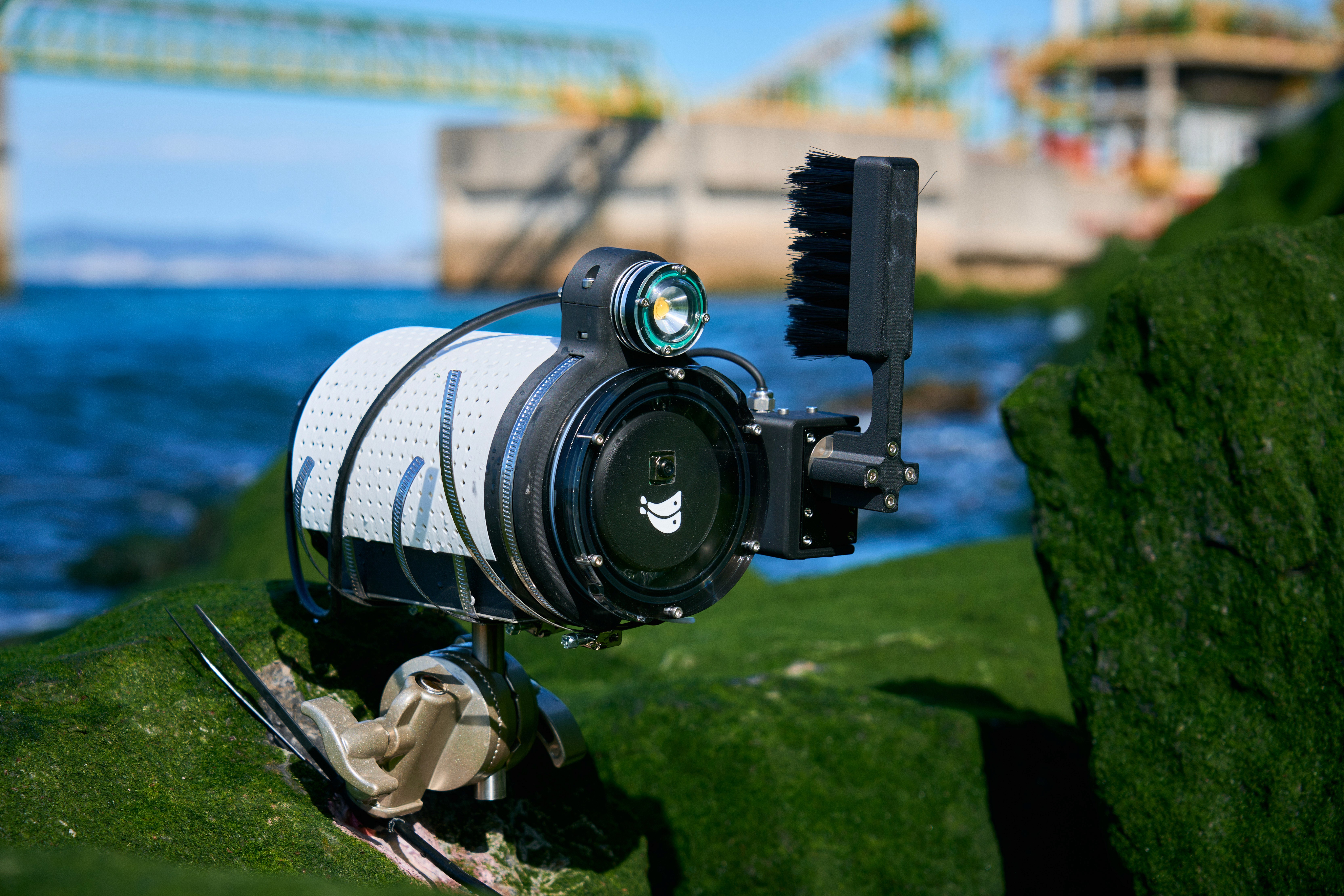
AnemoCam runs for about three months on its standard battery, depending on the monitoring protocol. A typical protocol is one short clip every 30 minutes. A larger battery pack extends this to as much as 24 months. The battery and storage canister can also be swapped underwater without lifting the camera. Wired cameras such as AnemoLive have no battery limit.
How do you stop biofouling on underwater cameras?
There are three ways to stop biofouling on an underwater camera: clean the lens mechanically, coat it, or retrieve the camera before growth builds up. Coatings slow growth but wear off, and many rely on biocides. Frequent retrieval works for short surveys and gets expensive for long ones. A mechanical wiper removes growth before it can settle and uses no chemicals.
AnemoCam and AnemoLive include a motorized lens wiper as standard, which cleans the lens before recording. One camera came back after six months in the Hudson River covered in growth, with a clear lens.
Can underwater cameras record fish at night without disturbing them?
Yes. Underwater cameras can record fish at night with the right light. White light gives the best image and color but can attract or repel some species. Red light is a common choice, because many fish see it poorly. In one stereo-video study of nocturnal reef fish, more fish were recorded under red light than under white or blue. Keeping the light off except while a clip is recorded reduces the effect further.
AnemoCam’s lights switch on only during recording, and a red filter is available. In the MOSAR project, red light around dusk and dawn covered the hours when many species are most active.
Can a stereo camera measure fish length and biomass?
Yes. Two calibrated lenses see the same fish from slightly different angles, which gives its distance from the camera and its length. Biomass then comes from published length-weight relationships for the species. Accuracy depends on calibration and on the fish being in view of both lenses.
AnemoCam and AnemoLive record through two factory-calibrated lenses in one camera unit, so stereo footage is collected from the first day of a deployment. Automated length measurement is coming soon to AnemoHub.
Can an underwater camera run off a wind turbine’s power and data connection?
In principle, yes: an underwater camera can run on a wind turbine’s power and data connection. A wired camera needs power and a network link within cable reach, whether they come from shore, a platform or a foundation. With a fixed connection the camera has no battery limit, and footage arrives without retrieval trips.
Offshore, the deciding factor is whether the operator can provide a connection point and a cable route, so raise it early in the design. AnemoLive is powered and connected over Power over Ethernet, with a recommended maximum cable length of 100 m. Where no connection is available, the battery-powered AnemoCam does the same job with service visits.
Can underwater cameras be mounted on turbine foundations and existing structures?
Yes. Cameras can be fixed to foundations, quay walls, piles and reef modules, or placed beside them on a seabed lander. Mounting on the structure gives the closest view of how animals use it. A lander works when nothing can be attached, or when you want a view from set distances.
Near Helgoland, Anemo’s cameras stand on landers 2 m, 10 m and 40 m from reference structures. Where no standard mount fits, we design a lander for the site and supply drawings so it can be built locally.
How many cameras does a monitoring site need?
The number of cameras a site needs depends on the question the study has to answer. There is no fixed number. Comparing a structure with a control needs cameras at both, and more than one at each, so a single unusual spot does not decide the result. Measuring a gradient needs a camera at each distance.
Three examples: MOSAR used six cameras, three at reef sites and three at matched controls. SeaMe uses nine cameras on three landers at three distances. In the Maldives, seven cameras covered artificial reefs at three restoration sites and one natural reef reference. We help set camera numbers, positions and recording intervals as part of the study design.
How much maintenance do long-term underwater cameras need?
Three things set the service interval: battery, storage and lens fouling. A battery camera needs a visit when the battery or storage runs out, and a wired camera does not. Without protection, fouling forces the shortest interval, because fouling can degrade a marine sensor’s measurements in less than a week.
On AnemoCam the wiper handles fouling, so visits are set by battery and storage. Storage is 2 TB as standard, with larger options. The battery and storage canister can be swapped underwater without taking the camera out, so the camera keeps its position and view.
What is the difference between AnemoCam and AnemoLive?
AnemoCam and AnemoLive differ in how they get power and deliver footage. AnemoCam is battery-powered and self-contained. It records clips at intervals set by the monitoring protocol and stores them until the canister is collected, which suits sites with no infrastructure. AnemoLive is the same camera unit, powered and connected by cable. It streams live and has no battery limit, which suits ports, coastal structures and any site with a connection within about 100 m.
Both record through two factory-calibrated lenses, include the lens wiper as standard and are rated to 100 m depth.
Analyzing underwater video
Can AI automatically identify and count fish in underwater video?
AI can find and count fish in underwater video automatically. Species identification still needs an expert’s check. A trained model detects fish in each frame, proposes a species and counts them at high throughput. With similar-looking species, juveniles or poor visibility it makes mistakes that an ecologist has to catch. Put simply: the AI does the finding, your ecologist does the identifying.
In AnemoHub, experts annotate a sample of footage, train a model on it and review its detections before any numbers are used. Accuracy varies by site and species, so we can benchmark a model on your own footage first.
How can I get through hours of survey video faster?
Train a model on a sample of your footage, then review its detections instead of watching every clip.
There is real work up front. In AnemoHub, about 100 annotations per species are enough to train a first model. Detections come back sorted by confidence, so reviewers start with the uncertain ones. In the Maldives project, about 3,000 annotated frames trained a model that then analyzed about 250,000. A trained model can be reused on the next deployment, though new species or conditions may need more annotations.
Does AI count individual fish or detections?
AI counts detections, not individual fish, unless a method is applied to turn them into abundance. A detection is one fish found in one frame, so a fish that stays in view is detected many times. Detection counts measure activity at the camera, not the number of fish in the area.
For abundance, video surveys use MaxN: the maximum number of individuals of a species seen in a single frame. Our method also requires the same or a higher count in the next frame, which guards against double counting. So a result such as “eight times more detections” describes activity, and abundance is reported separately as MaxN.
Can I train a fish detection model on my own species and site?
Yes. You can train a fish detection model on your own species and site, and for most sites you should. Species, light, background and turbidity differ from place to place, and a model trained elsewhere loses accuracy on new footage. You draw boxes around fish in your own footage, assign the species and train.
In AnemoHub this happens in the browser. About 100 annotations per species start a first model. You then check accuracy per species, add annotations where the model struggles and train again. One limit to know before you evaluate: models cover fish and other mobile animals. There is no kelp model and no coral health model.
Can AI analyze footage from GoPros, BRUVs and ROVs?
Yes. AI can analyze footage from GoPros, BRUVs and ROVs if the image is good enough to tell species apart by eye. A model does not care which camera recorded a clip. It does care about resolution, lighting, motion and viewing angle, so footage from a moving ROV usually needs its own annotations.
AnemoHub accepts footage from Anemo cameras, GoPros, BRUVs, ROVs and video archives, in MP4, AVI, MOV and MKV. You can use it without changing your cameras.
Reports, cost and getting started
What is included in a marine biodiversity monitoring report?
A good marine biodiversity monitoring report states the question, the monitoring protocol and the sampling unit, then gives the results with their limits. For a camera study the usual contents are species richness, abundance as MaxN, activity through day and night, heatmaps of where each species was detected, and comparisons between sites or periods.
AnemoReport is our reporting output, scoped to the questions a project needs answered. Beyond the standard measures it can cover residency (dwell time per species), schooling and co-occurrence, and habitat use inside and outside a structure. What can be reported depends on the footage and the study design. A report supports regulatory or grant requirements only when it is scoped for them.
How much does underwater biodiversity monitoring cost?
Five things drive the cost of underwater biodiversity monitoring: the number of cameras, the length of the deployment, how hard the site is to reach, how the cameras are mounted, and how much analysis and reporting you need. Offshore, vessel time is often the largest single item, at about EUR 12,000 to 15,000 per day for a survey vessel. Methods that need fewer trips therefore cost less over a long program.
To compare options, price the whole program and not only the equipment: mobilizations, service visits, expert hours for video review, and reporting. Pricing depends on the project. Contact us for a quote.
Can you rent underwater monitoring cameras?
Yes. Underwater monitoring cameras can be rented, usually on a lease. Leasing suits studies with a fixed end date, such as a one-year baseline or a construction-phase program. Check what a lease includes: mounts, spare batteries, support during deployment, and whether analysis is part of it.
Can a consultancy subcontract the monitoring, or only the video analysis?
A consultancy can subcontract either the full monitoring or only the video analysis. Some consultancies bring us in for cameras, deployment support and analysis as one package within their assessment. Others keep their own field methods and send footage from BRUVs, ROVs or drop cameras for analysis only.
In both cases the ecological interpretation stays with your team. Your ecologists review the detections and confirm the species, and the conclusions in the client report are yours. Your team can also deploy and retrieve the cameras with remote support from us. In the Maldives, Van Oord carried out the deployment itself.
Can I try AnemoHub before committing?
Yes. AnemoHub is open for early access. Currently access is by invitation only. Invited users get a free trial account with up to 250 GB of storage, enough to upload footage, annotate and train a first model. Interested in trying AnemoHub? Request access.
Still have a question?
Every site is different. Tell us what you need to find out, and we will tell you whether cameras are the right method for it.
